

 Share
The slot machines you recognise today started with a problem that casino engineers had to solve. Poker was popular, but getting a machine to recognise winning hands and pay players automatically was another story. The solution changed casino gaming completely.
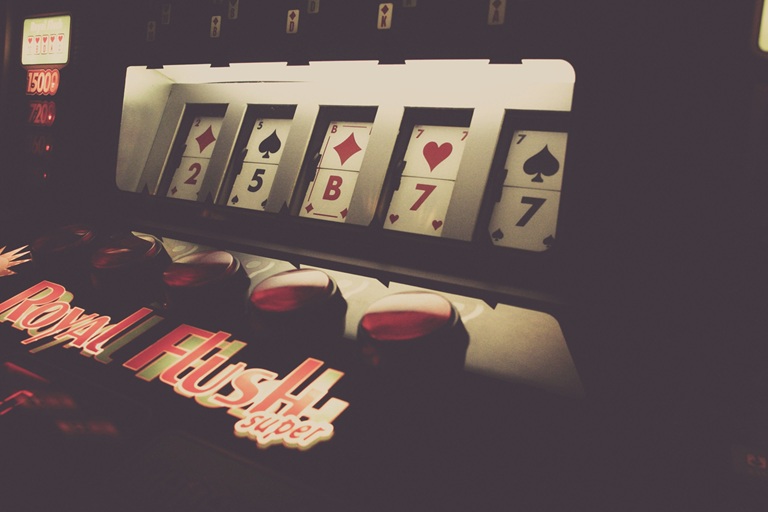
The first slot machines had a lot more in common with poker than the pokies you play today. In 1891, a machine built in Brooklyn used five rotating drums displaying playing cards, with the result determined by the poker hand that appeared when the drums stopped. There were no spinning fruit symbols or matching sevens. The idea was simple enough: people already knew poker, so the manufacturers built a machine around a game they understood.
That early design also presented a problem: displaying a poker hand was straightforward, but getting a machine to recognise the result and pay the correct prize was considerably harder. Solving that problem eventually gave us the three-reel slot machine.
Poker Hands and the Problem of Payouts
In 1891, the New York company Sittman and Pitt developed a coin-operated poker machine with five rotating drums displaying 50 playing-card faces. Pulling the lever produced a poker hand, with winning combinations determined by the same rankings players already understood.
Gambling historian David G. Schwartz described the invention as “an early, analog video poker machine”. The comparison works because both games produce poker hands, although the original machine relied entirely on mechanical parts.
The problem was paying the winners. A saloon attendant could recognise a full house or a straight flush immediately, but building machinery to identify every combination and award the correct prize was considerably harder.
Early machines therefore relied on attendants to provide prizes, often drinks or cigars. Manufacturers also removed certain cards from the drums, reducing the chances of hitting valuable combinations.
The next improvement was obvious: a machine that could recognise winning results and pay customers automatically, without involving someone behind the bar.
Charles Fey and the Three-Reel Solution
Charles Fey approached the problem by simplifying the game itself. His Liberty Bell machine, developed in San Francisco in 1898, used three reels carrying a limited selection of symbols instead of five drums displaying playing cards.
With ten positions on each reel, the machine had 1,000 possible combinations. Its mechanism could recognise designated winning combinations and release coins automatically.
SFO Museum documented Fey’s Liberty Bell and other early gambling machines in its 2016 exhibition, Games of Chance: Gambling Devices of the Mechanical Age.
The difference between the machines becomes clearer when you put their designs alongside each other.
Fey’s design changed the relationship between the player and the machine. Winning no longer depended on an attendant recognising a poker hand and providing a prize.
The reels stopped, the mechanism checked the combination and the machine paid according to its design. That was a much more practical arrangement for a coin-operated game.
From Saloon Machines to Mechanical Gaming
Coin-operated gambling machines became part of the entertainment offered in American saloons around the turn of the twentieth century. They gave customers another activity between drinks, and operators had a machine that collected money without needing a dealer for every game.
The interest in mechanical betting systems extended beyond American saloons.
In New Zealand, engineers were developing totalisators for horse racing. These machines recorded wagers mechanically, keeping track of bets placed on individual horses and the overall pool.
The University of Auckland’s Department of Computer Science documents five surviving early New Zealand totalisator machines, including examples preserved at Ellerslie and MOTAT.
A totalisator served a different purpose from a slot machine, but both belonged to an era when engineers were finding mechanical solutions to jobs previously handled by people.
For the slot machine, automatic payouts were the crucial advance. For the totalisator, mechanical counting made it possible to process large numbers of racing bets. Both demonstrate the practical value of machinery in gambling businesses.
The Reel Format Finds Its Identity
Once manufacturers had a working three-reel system, they no longer needed poker hands to give the machine a recognisable game.
Fruit symbols became associated with later machines, while bells remained a popular part of slot imagery. Players learned to recognise winning combinations from the symbols appearing across the reels.
The basic playing process became established:
- Insert a coin and activate the reels.
- Watch the symbols stop and check the resulting combination.
- Receive a payout when the mechanism identifies an eligible result.
That straightforward arrangement helped the reel machine develop an identity separate from poker.
Poker continued along its own mechanical and electronic path, eventually becoming the video poker game played today. The distinction between poker outcomes and reel outcomes is still useful when considering the difference between improving outs and winning outs in card games.
Reel games followed a different principle: each completed spin produced its own result, without asking the player to build a poker hand.
From Mechanical Reels to Modern Pokies
Physical reels remained central to slot machines for decades, although the machinery controlling them became more sophisticated. Electromechanical machines introduced electrical components, and later electronic systems made it possible to determine results without relying on the position of a physical reel.
Modern online pokies use software to generate outcomes and display the results through animated reels. Random number generators determine the results, while the screen presents the symbols and any associated game features.
The connection to the original three-reel machine is still obvious when you watch a modern game. You start a spin, the reels move and the symbols stop in their final positions.
The difference is what happens around that basic action.
Modern pokies still use spinning reels, but software allows developers to introduce game features that mechanical machines could never support. Gates of Olympus 1000, available in the VegaStars pokies library, uses a tumble mechanic that removes winning symbols and replaces them with new ones. The game still depends on symbols producing winning combinations, although the way those combinations appear has changed considerably since Fey’s original machine.
The development has also changed how players find games. Instead of choosing between a handful of machines in a saloon, an online player can browse a catalogue organised into game categories.
That organisation is part of the VegaStars NZ experience, where pokies sit alongside live-dealer games and dedicated high-roller selections. The original machine was a self-contained mechanical game; today’s online casino brings several different forms of gambling into one digital environment.
The Poker Connection That Survived
Poker gave the earliest slot machines a practical starting point. Players already understood the cards and winning hands, so manufacturers could concentrate on building machinery that reproduced the game.
Fey’s three-reel design solved a different problem by simplifying the combinations and allowing the machine to pay automatically.
Modern pokies have moved far beyond those mechanical beginnings. At VegaStars, software-driven titles from providers including Hacksaw Gaming demonstrate how much variety the reel format now supports.
Yet the basic action remains recognisable. A player starts the game, watches the result appear and finds out whether the combination wins.
The earliest machines borrowed their rules from poker. The three-reel design gave slots a game of their own.
Online casino games are intended for adults aged 18 and older. Gambling involves financial risk. Set spending limits, play for entertainment and stop when gambling is no longer enjoyable.